
Tag: medieval
-
The Aberdeen Bestiary
—
in GeneralThe Aberdeen Bestiary (Aberdeen University Library MS 24) is considered to be one of the best examples of its type due to its lavish and costly illuminations. The manuscript, written and illuminated in England around 1200, is of added interest since it contains notes, sketches and other evidence of the way it was designed and…
-
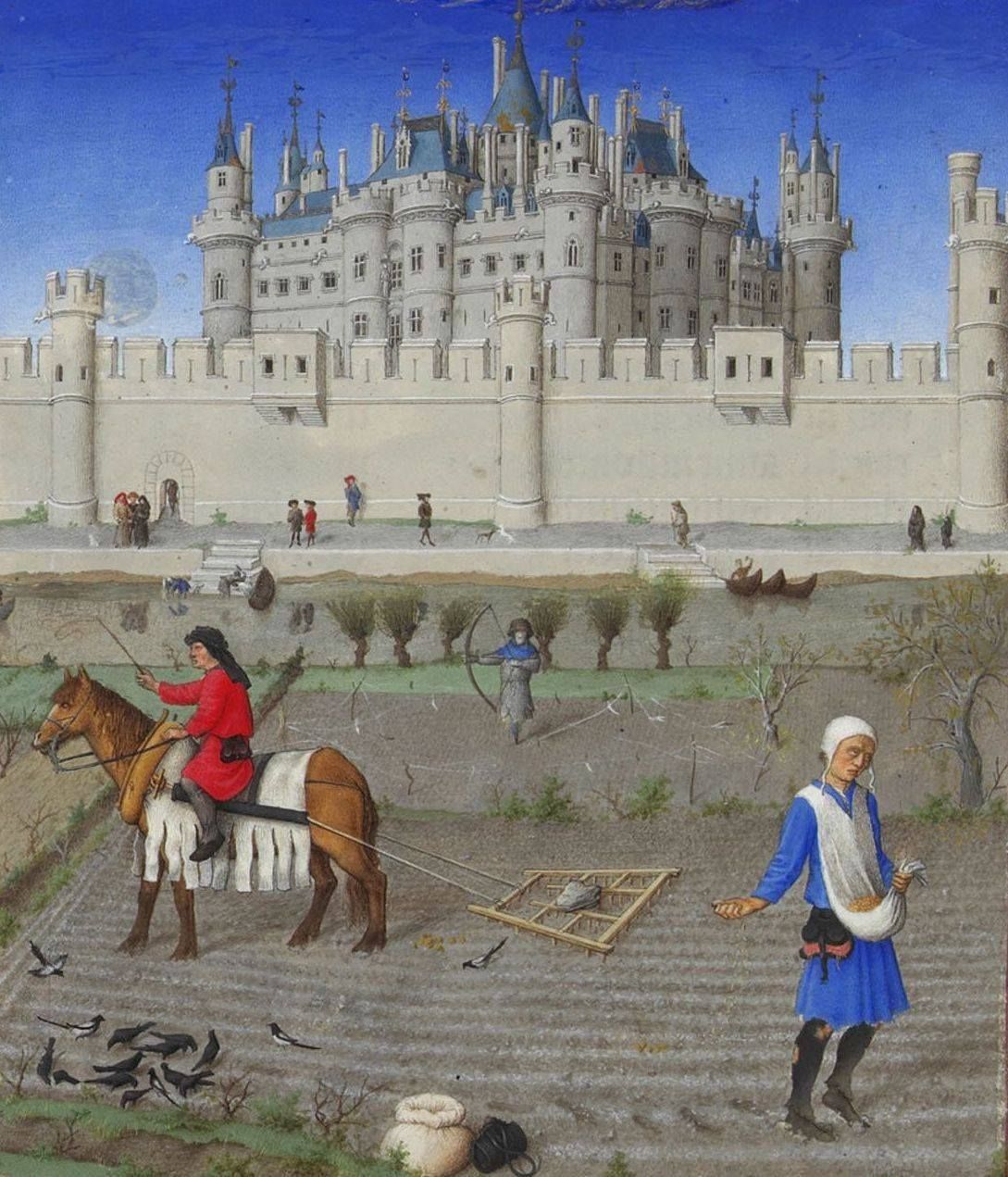
Tres riches heures – Labor of the month
—
in IspirazioneScene representing October, from the 15th-century Très Riches Heures (known as the “king of illuminated manuscripts”). Note the rather bored looking seed-sower and scarecrow with bow and arrow. The scene is taking place at what would now be the centre of Paris (a block or two south of l’École nationale supérieure des Beaux-Arts).
-
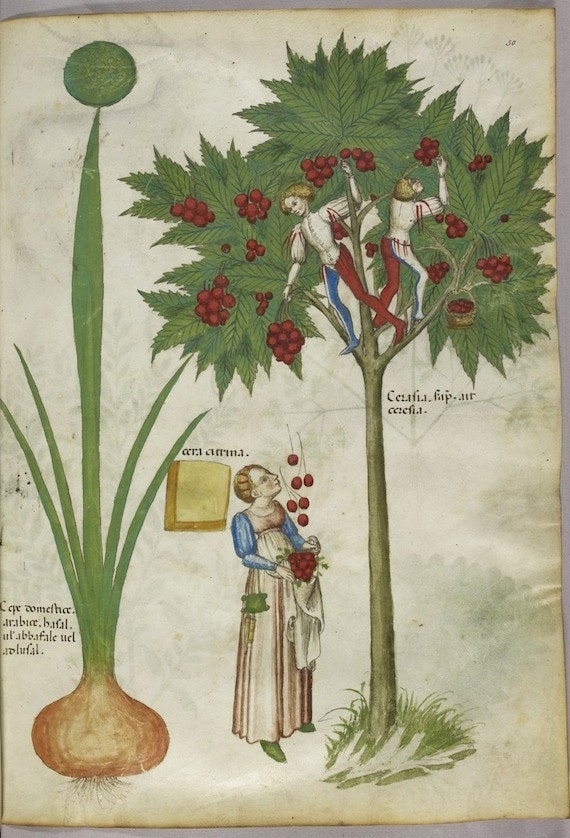
Plant and boys in the branches
—
in GeneralMiniature of a plant and boys standing in the branches of a fruit tree picking fruit and thowing down to a woman standing below. From Tractatus de Herbis (ca.1440)
-
Tractatus de Herbis (ca.1440)
—
in GeneralSelections from a beautifully illustrated 15th century version of the “Tractatus de Herbis”, a book produced to help apothecaries and physicians from different linguistic backgrounds identify plants they used in their daily medical practice. No narrative text is present in this version, simply pictures and the names of each plant written in various languages –…
-
Johannes Hartlieb’s Book of Herbs (1462)
—
in GeneralThis 1462 Kräuterbuch (“Book of Herbs”) by Johannes Hartlieb enfolds, verbatim, much of Konrad von Megenberg’s Buch der Natur, published a century earlier and considered by scholars to be the first natural history written in German. (The Buch der Natur itself reworked herbals by Thomas of Cantimpré and Albert Magnus, who, in turn, borrowed heavily from Arabic botanical handbooks.) Unlike…
-
The Voynich Manuscript
—
in GeneralThere are countless objects that defy understanding, but the Voynich manuscript is perhaps one of the most confounding. Named after the rare books collector Wilfrid Voynich, who acquired it in 1912, the manuscript continues to baffle skilled cryptologists to this day. In fact, it’s never even been deciphered.